

Jean Royère – Works & Design
Overview
Jean Royère (1902–1981) was a French decorator and designer who worked almost entirely on commission: complete interiors, furniture and lighting for private clients, hotels, embassies and palaces. He had no formal training. His wave-shaped metal tubing, plant and animal titles and bold colours set him apart from both the austere modernists and the period-style decorators of his time. His best-known pieces are the Ours Polaire sofa and the Liane wall lamp.
Le Havre and Paris, 1902–1942: A self-taught decorator
Royère was born in Paris in 1902. After classical schooling, law studies and a stay at Cambridge, he did his military service in 1925 and then worked in Le Havre for his uncle's import-export firm until 1931. Encouraged by Louis Metman, chief curator of the Musée des Arts Décoratifs, he turned to decorating at 29 and learned the trade in a furniture workshop in the Faubourg Saint-Antoine. His first work was for his uncle. In 1932 he furnished the surgery and apartment of Dr Philippe Decourt in chromed tubing, and in 1933 the brasserie of the Hôtel Carlton on the Champs-Élysées brought his breakthrough.
In 1934 he joined Pierre Gouffé, a house better known for period reproductions, where a modern department was created for him. At the 1937 World's Fair he received seventeen commissions. At the 1939 Salon des Artistes Décorateurs, held together with the Salon de la Lumière, he showed a boudoir with the Champignon standing lamp, the Trèfle chair and the Éléphanteau armchair; critics called it "fairground Baroque". After the war years, during which he stayed with Gouffé, he opened his own agency at Rue d'Argenson in Paris in 1942.
Cairo, Beirut, Tehran, 1946–1963: Interiors abroad
From 1946 Royère turned to foreign markets: a gallery in Cairo (1946), an agency in Beirut with the architect Nadim Majdalani (1947), later branches and projects in Iran, Saudi Arabia, Lima and São Paulo. His first public commission was the French consulate in Alexandria (1948). Other major jobs were the Hôtel Le Capitole in Beirut (1953) and, for the Iranian court from 1958, palace interiors and the Senate building in Tehran. In Paris he moved to a larger gallery at 182 Rue du Faubourg Saint-Honoré in 1949. He took part in the Salon des Artistes Décorateurs until 1959, retired in 1972, moved to the United States and died in Pennsylvania on 14 May 1981.
Design language
Royère used metal tubing in a custom diameter instead of the standard industrial one and bent it into undulating lines – a motif he called Ondulation and then developed into vines, clover leaves and branches. He treated the plant and animal world as a pretext, not as a model: the title of a piece names an idea (Hirondelle, "swallow", also alludes to the dovetail joint of the Faubourg Saint-Antoine workshops). Materials ranged from patinated, gilded or lacquered iron and brass to rattan, straw marquetry, dried flowers, opaline glass and faux fur. Colour was part of the concept: strong contrasts instead of the "good taste" beige of the 1950s.
Lighting
Royère designed lighting as part of the room, mostly as wall lamps, standing lamps and chandeliers made of wrought or lacquered metal. Models documented in the catalogue literature:
Champignon, standing lamp, shown 1939; later versions from the 1940s.
Anneaux, standing lamp, shown 1939 at the Palais Galliera; versions around 1950.
Bouquet, wall lamps and chandeliers from 1939 (ten-branch wall lamp), with versions in the late 1940s and 1950s.
Ondulation, wall lamps from 1948 and around 1950, chandeliers around 1939 and 1953.
Tour Eiffel, standing lamp and table and console series, around 1947.
Hérisson, large chandelier for the French consulate in Alexandria, 1948, with a standing-lamp variant.
Hirondelle, wall and standing lamps with two to nine arms, around 1948 to 1953.
Persan, wall and standing lamps in brass or gilded metal, around 1950 to 1954.
Mille pattes / Mille pieds, standing lamp shown in 1952.
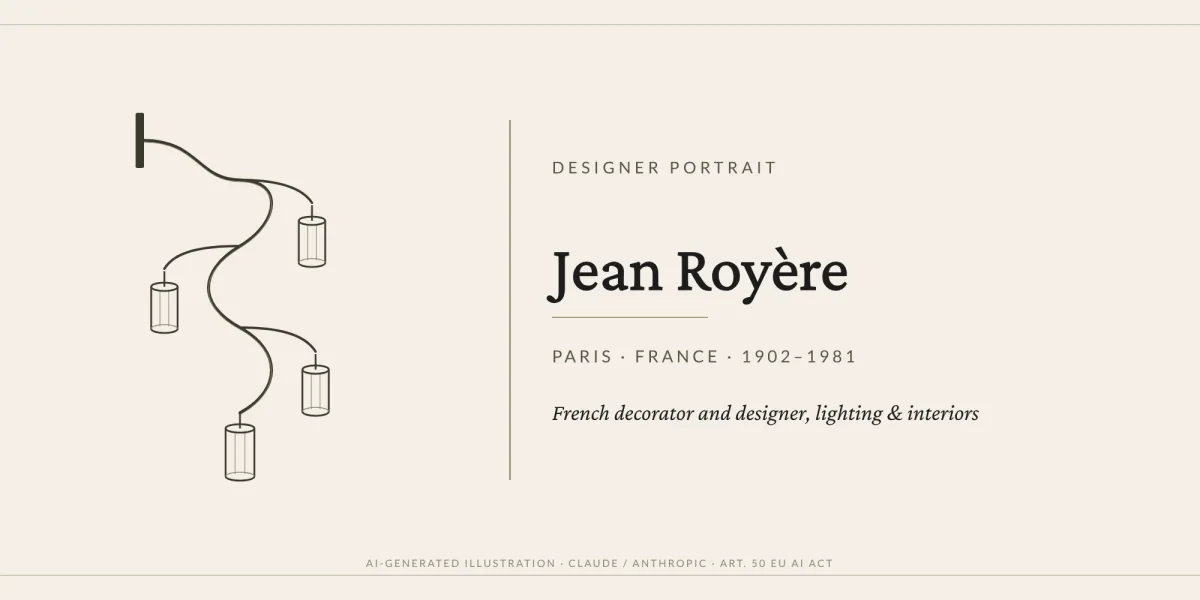
Liane, wall lamp with cylindrical shades hanging like bellflowers: first known execution around 1955 (a model of 1952 already shows the idea), standing lamp first shown in 1959.
Royère also used lamps by others in his interiors, for example Danish Leklint paper lamps; these are not his designs.
Attribution and later production
Royère worked to order and in many variants, so dimensions, colours and numbers of arms differ. Published catalogue descriptions of period lamps do not mention maker's marks; attribution rests on provenance, archive documents and publication. His own archive is held by the Musée des Arts Décoratifs in Paris, a second archive by the galleries Jacques Lacoste and Patrick Seguin. Since 2018 the estate has licensed a new production under the name Royère (formerly Maison Royère); according to the company, new pieces carry a stamp or plaque and a certificate. Lamps "in the style of" or "after" Royère are widespread on the market. In 2023 a US court found that copies of several models, including the Liane wall lamp, infringed the estate's copyright.
Collections and literature
The Musée des Arts Décoratifs in Paris owns his archive, furniture such as the Boule sofa (1947) and a Liane lamp; the Centre Pompidou holds furniture. Principal literature: Jean Royère, 2 vols., Galerie Jacques Lacoste / Galerie Patrick Seguin, Paris 2012; Jean-Luc Olivié (ed.), Jean Royère, décorateur à Paris, Musée des Arts Décoratifs / Norma, 1999; Pierre-Emmanuel Martin-Vivier, Jean Royère, Norma, 2002.