

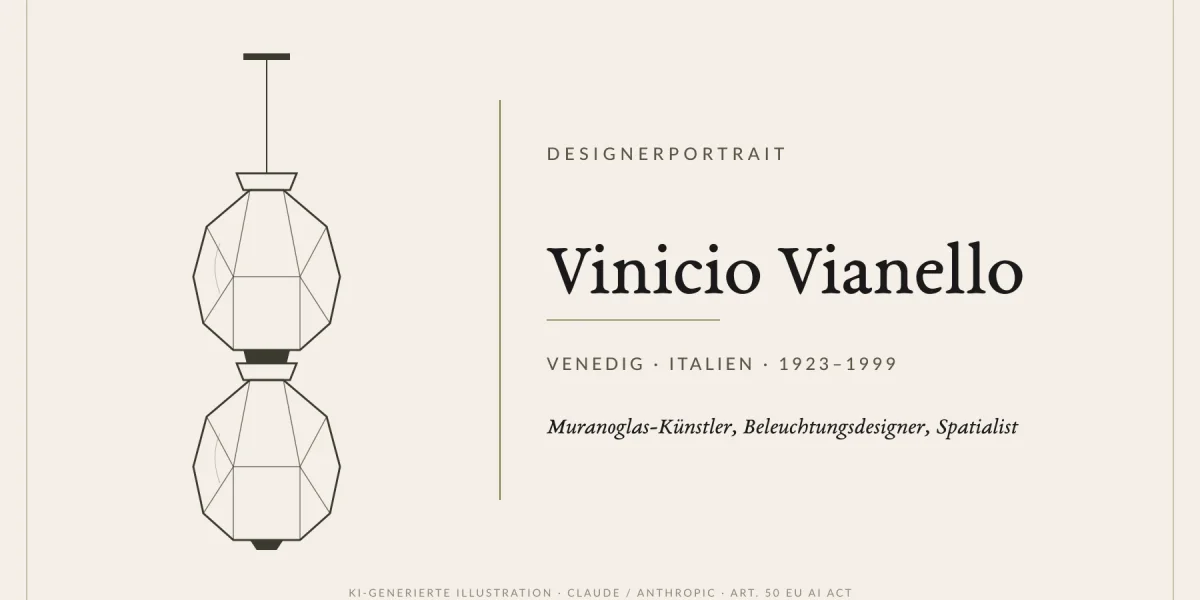
Vinicio Vianello
Vinicio Vianello (1923–1999) – Designerprofil, venezianischer Glaskünstler und Beleuchtungsdesigner
Ausbildung und frühe Jahre
Vinicio Vianello wurde am 29. April 1923 in Venedig geboren und starb 1999 in Zelarino (Provinz Venedig). Er studierte an der Accademia di Belle Arti in Venedig und begann Anfang der 1940er Jahre mit Ausstellungen. In den unmittelbaren Nachkriegsjahren fand er Anschluss an die Gruppe der Spatialisten (Spazialismo), die von Lucio Fontana initiierte, zwischen Mailand und Venedig aktive Bewegung, und arbeitete eng mit der Galleria del Cavallino von Carlo Cardazzo zusammen. Obwohl er sein Leben lang quer zu den offiziellen Kunstströmungen blieb, prägte diese spatialistische Grundhaltung — mit ihrer Betonung von Material, Geste und der Physikalität des Lichts — sein gesamtes Werk in Glas, Design und Beleuchtung.
Vom skulpturalen Glas zur modularen Beleuchtung
Vianello näherte sich dem Glas als künstlerischem Ausdrucksmittel, besuchte mehrere Muraneser Öfen und studierte die Techniken und Handfertigkeiten der Meister. Seine ersten Arbeiten, präsentiert auf der Biennale Venedig 1950, wurden vom Meister Alfredo Barbini ausgeführt und zeichneten sich durch bewusste Asymmetrie aus — ein gezielter Bruch mit den jahrtausendealten Parametern der Muranoglas-Tradition. 1952 kehrte er mit der Serie Reazione nucleare (Nuklearreaktionen) zur Biennale zurück, großen abstrakten Vasen des Meisters Ferdinando Tosi, und entwickelte kurz darauf die berühmte Milleocchi-Serie („Tausend Augen") für S.A.L.I.R. (Studio Ars et Labor Industrie Riunite), gekennzeichnet durch linsenförmige Gravuren, die Licht mit ungewöhnlicher Intensität einfangen und reflektieren. 1956 wurde er vom Assessorat für Arbeit der Region Venetien mit der Kuratierung der großen Muranoglas-Ausstellung am Röhsska Konstslöjdmuseet in Göteborg beauftragt, deren räumliche Anordnung — nach Größe und Farbe vor einem großen Fenster organisiert — ihm breite Kritikeranerkennung in Nordeuropa einbrachte.
1957: Compasso d'Oro und Beginn der Beleuchtungsarbeit
Das Jahr 1957 markiert den entscheidenden Wendepunkt. Vianello erhielt den Compasso d'Oro (La Rinascente-Preis) sowie den Grand Prix der XI. Triennale Mailand für seine Blasglasarbeiten. Im selben Jahr begann er mit der Produktion von Blasglas-Leuchten auf modularen formalen Systemen — ein industrieller Designansatz statt eines rein künstlerischen. Das bekannteste Ergebnis ist die Pendelleuchte Nelson, produziert von Vistosi, deren patentiertes Innensystem den Strom über einen elektrifizierten Messingstab zum Glasdiffusor leitet — mittels Kontaktpunkten aus Messing und Bakelit, ohne sichtbare Kabel. Diese technische Lösung ließ Vianello Anfang der 1960er Jahre patentieren (italienische Industriemuster-Patente Nr. 84163 für „Elemente für zerlegbare Leuchten" und Nr. 85428 für „Tischleuchtenständer mit Glasdiffusor").
Zentrale Leuchtenmodelle
Zwischen den späten 1950er und späten 1960er Jahren entwickelte Vianello einen kohärenten Katalog von Leuchten, die Muranoglas-Diffusoren mit Gestellen aus Messing, verchromtem Messing oder brüniertem Metall verbanden. Zu den wichtigsten Modellen zählen Nelson (1957–1958), Tisch- und Deckenvariante mit dem patentierten Modulsystem; Drake (1959), vor allem als Wandapplike mit polygonalen Blasglas-Elementen bekannt; Grove und Sansone (1960), Pendelleuchten; Fungo (1960), Tischleuchten in Pilzsilhouette; Corolla (1964), ein Kronleuchter aus geripptem Kristall- und Bernsteinglas mit brünierten Messingfassungen (produziert von Salviati & C.); Eclisse (1965), eine Drehleuchte für den Tisch aus Kristall und verchromtem Messing, auch in Bernstein für das Joy Hotel in Rom ausgeführt; Perseo (1966), eine Tischleuchte aus schattiertem Opalinglas und verchromtem Messing, auf der Weltausstellung Montreal 1967 gezeigt; sowie Lanterna (1968), in urbaner Straßenbeleuchtung von Rom bis Tunis eingesetzt. Parallel arbeitete Vianello an der beweglichen Leuchte Lucesnodo (1962–1969), unter anderem im Bürogebäude von Rom EUR eingesetzt, sowie an Laguna und Magellano (1962–1966).
Hersteller
Vianellos Beleuchtung wurde von mehreren Muraneser und venezianischen Glashütten und Werkstätten realisiert:
Vistosi (Murano) — Hauptpartner ab 1957 für Pendel-, Wand- und Kronleuchten, darunter das Nelson-System, Drake-Wandappliken und mehrkugelige Messing-Kronleuchter
Vetreria Salviati (Murano) — Muranoglas-Kronleuchter mit Metallstruktur ab 1956 und in den Folgejahren, darunter der Corolla-Kronleuchter von 1964
S.A.L.I.R. (Studio Ars et Labor Industrie Riunite, Murano) — Milleocchi-Serie mit Linsengravur und weitere gravierte Objekte ab Mitte der 1950er
Alfredo Barbini und Ferdinando Tosi (Muraneser Meister) — Ausführende der frühen asymmetrischen und nuklearthematischen Vasen
Große Architekturbeleuchtungs-Aufträge
Ab Ende der 1950er Jahre arbeitete Vianello zunehmend an großen architektonischen Beleuchtungssystemen auf Basis der von ihm patentierten Modulkonzepte. Dokumentierte Projekte sind unter anderem die Beleuchtung der Villa di San Rossore (Präsidentschaftsresidenz der Italienischen Republik, 1959); Tisch- und Deckenlampen der Nelson-Serie für den italienischen Ozeandampfer Turbonave Leonardo da Vinci (1960); die Hängebeleuchtung des Café-Shops im Hotel Cavalieri in Rom (1963), die Vianello selbst als Beginn seiner großen modularen Lichtinstallationen bezeichnete; der Corolla-Kronleuchter für das Istituto Banca in Rom; die Lucesnodo-Installation im Bürogebäude Rom EUR; die Beleuchtung des Joy Hotel in Rom; sowie die Beleuchtung des Denkmals für den Unbekannten Soldaten in Baghdad — laut Skira-Monografie durch die ersten „intelligenten Bomben" des Golfkriegs zerstört.
Späte Jahre, Solarexperimente und Vermächtnis
Quellen (mehrsprachig)
Italienisch (Primärquellen)
L. M. Barbero (Hg.), Vinicio Vianello. Pittura, vetro e design, Skira, Mailand 2004 — Referenzmonografie
G. C. Argan (Hg.), Vinicio Vianello. Creazioni e produzioni esclusive, Stampa Fantonigrafica, Venedig 1977
A. Bassi, P. Marini, A. Di Lieto (Hg.), Vinicio Vianello. Il design del vetro, Marsilio, Venedig 2007 (Ausstellungskatalog Museo di Castelvecchio)
A. Bassi, La luce italiana. Design delle lampade 1945–2000, Electa, Mailand 2003
M. Barovier, R. Barovier Mentasti, A. Dorigato, Il vetro di Murano alle Biennali 1895–1972, Leonardo Arte, Venedig 1995
Fondazione Giorgio Cini, Centro Studi Vetro — digitales Archiv mit Patenten, Katalogen, Ausstellungen: archivi.cini.it/centrostudivetro
Triennale Milano, Ausstellungsseite „Vinicio Vianello. Il design del vetro a Murano" (2024): triennale.org
Englisch
Nilufar Gallery, Mailand — Designerbiografie: nilufar.com/designers/vinicio-vianello
Bugno Art Gallery, Venedig — biografische Notizen: bugnoartgallery.com/vinicio-vianello
MuranoNet — biografischer Artikel: muranonet.com/blogs/unfold-venice/vinicio-vianello
Unforget (Belgien) — Dokumentation der Milleocchi-Serie: unforget.eu
1stDibs, Pamono, InCollect — Auktions- und Händlerreferenzen für Leuchten von Vistosi, Salviati und S.A.L.I.R.
Französisch
Piasa (Paris), Auktionskataloge 2024 — Paar Pendelleuchten Vinicio Vianello, ca. 1957
Präsenz von Vianello-Beleuchtung in französischen Händlerinventaren (über 1stDibs und Selency), häufig als „Vinicio Vianello édité par Vistosi" katalogisiert
Spanisch
Setdart Auction House (Madrid/Barcelona), Oktober 2024 — Vinicio Vianello für Vistosi, Wandleuchten-Element
Deutsch
Quittenbaum Kunstauktionen (München) — regelmäßige Auktionsergebnisse zu Vinicio Vianello (Muranoglas)
Ausstellung der dekorativen Kunst in Venetien, Kassel/Köln/Dortmund/Frankfurt/Würzburg 1958–59 (deutsche Wanderausstellung venezianischer dekorativer Künste, u.a. mit Vianello)
Schwedisch
Röhsska Konstslöjdmuseet, Göteborg — Muranoglas-Ausstellung 1956, kuratiert von Vianello (institutioneller Nachweis)
Quellenehrlichkeit
Einige Händlerbiografien nennen als Geburtsjahr 1924 statt 1923. Die Fondazione Giorgio Cini (Centro Studi Vetro), die Triennale Milano und die Skira-Monografie dokumentieren konsistent den 29. April 1923; dieses Portrait folgt dem Primärquellen-Datum. Die Zuschreibung des Corolla-Kronleuchters wird in der Skira-Monografie als „Salvati & C., Rom" angegeben; ob dies die römische Werkstatt Salvati & C. oder die Muraneser Vetreria Salviati bezeichnet, lässt sich aus dem verfügbaren Material nicht abschließend klären und wird hier als offene Frage vermerkt.