

Einar Bäckströms Metallvarufabrik
Einar Bäckströms Metallvarufabrik (Malmö, gegründet 1918) – schwedische Manufaktur für elektrische Beleuchtungsarmatur und dekoratives Metallhandwerk
Unternehmen und Herkunft
Einar Bäckströms Metallvarufabrik – im schwedischen Sprachgebrauch häufig kurz „EBM" oder „Bäckström Malmö" genannt – zählt zu den langlebigsten und stilprägendsten Beleuchtungsmanufakturen Südschwedens. Die Firma wurde 1918 in Malmö von den Brüdern Einar Bäckström (geb. 1889, gest. 1978) und Sune Bäckström gegründet. Beide Brüder waren gelernte Ziseleure (schwedisch: ciselörer), also Kunsthandwerker mit spezieller Ausbildung im Treiben, Meißeln und Feinbearbeiten von Metall. Diese handwerkliche Grundlage prägte den Charakter der gesamten Produktion über sechs Jahrzehnte hinweg.
Der erste Firmensitz wurde noch im Gründungsjahr 1918 in Malmö an der Adresse Stora Nygatan 57 eingerichtet. Ausweislich zeitgenössischer Handelsregisterangaben (Referenz 1923) diente der Betrieb dem Zweck „der Herstellung von Beleuchtungsarbeiten und Prydnadsartikeln [dekorativen Zierartikeln] sowie dem Groß- und Einzelhandel mit diesen Erzeugnissen". In den frühen 1920er Jahren erfolgte der Umzug in eine größere Manufaktur an der Föreningsgatan 8, die bis zur Schließung 1975 das Hauptwerk der Firma blieb. Dort waren Verwaltung, Fabrikation und ein repräsentativer Ausstellungs- und Verkaufsraum unter einem Dach vereint. Zusätzlich unterhielt die Firma einen zweiten Ausstellungs- und Ladenraum an der Hamngatan 2, ebenfalls in Malmö.
Nach 57 Jahren ununterbrochener Fertigung wurde der Betrieb 1975 eingestellt. Damit endete eine der markantesten südschwedischen Leuchtenmanufakturen der Moderne. Die Marke lebt heute nur noch im internationalen Vintage- und Sammlermarkt fort, wo Bäckström-Leuchten zu den gesuchten Sammlerstücken des schwedischen Mid-Century-Modernismus gehören.
Die Gründer: Einar und Sune Bäckström
Einar Bäckström (1889 – 1978)
war der namensgebende Firmenchef, Werkstattleiter und – nach Angaben des Malmö Museums – zugleich Chefgestalter im Sinne eines „mönsterkomponist": Er komponierte laut Sammlungsdokumentation des Malmö Museums die gesamten Muster und Modelle des Hauses selbst. Bäckström ist damit einer der wenigen skandinavischen Leuchtenfabrikanten der klassischen Moderne, der die Entwurfstätigkeit über Jahrzehnte nicht in erster Linie externen Architekten überlässt, sondern konsequent im eigenen Betrieb bündelt. Sein Werk umfasst Deckenleuchten, Kronleuchter, Wand-, Steh-, Tisch- und Klavierleuchten sowie kunsthandwerkliche Zinn- und Bronzeobjekte. Bäckström führte den Betrieb bis in die Nachkriegszeit hinein und wurde 89 Jahre alt.
Sein Bruder Sune Bäckström
war Mitgründer und trat unter der eigenen Firmenmarke „Bäckström Tenn" in Malmö auch als Zinngestalter in Erscheinung. Sune Bäckström entwarf in den 1920er und 1930er Jahren nach der zeitgenössischen schwedischen „Swedish Grace"- und Art-déco-Ästhetik dekorative Zinngefäße, Bonbonnièren, Kerzenständer und Bronzekandelaber, die in derselben Werkstatt an der Föreningsgatan 8 gefertigt und teils über das Modehaus Nordiska Kompaniet (NK) in Stockholm vertrieben wurden. Diese frühen Zinnobjekte sind heute in Sammlerkreisen und im Verzeichnis schwedischer Zinnstempel unter dem Meistermerkmal „E.B." dokumentiert.
Stilentwicklung: von Art déco und Swedish Grace bis zum skandinavischen Modernismus
Die Fertigung von Einar Bäckström durchlief in fast 60 Jahren mehrere klar unterscheidbare Stilphasen und deckt damit fast die gesamte Bogenspannweite der klassischen skandinavischen Wohnleuchte im 20. Jahrhundert ab.
In den 1920er Jahren
– der Frühphase – ist das Werk dem internationalen Art déco und der schwedischen „Swedish Grace"-Bewegung verpflichtet. Charakteristisch sind Decken- und Stehleuchten aus Messing mit geometrischer Ornamentik, historisierenden Motiven und aufwendigen Oberflächenbehandlungen: grüne Oxidation (schwedisch „grönpatinerad"), Antikgold, Alt-Silber sowie farbige Lackierungen. Die frühe Werkstattpraxis ist geprägt vom handwerklichen Repertoire des Ziseleurs – jede Ornamentkante ist von Hand nachgearbeitet. In diese frühe Phase fällt auch die Herstellung dekorativer Zinngefäße, die u.a. 1925 in der Publikation Erik Wettergrens „L'art décoratif moderne en Suède" (Malmö Museum, anlässlich der Pariser Weltausstellung 1925) besprochen wurden. Aus dieser Zeit stammt die Swedish-Grace-Tischleuchte Modell 9095, die heute zu den frühen Sammlermodellen des Hauses zählt.
In den 1930er
Jahren wandelt sich das Formvokabular hin zu einer aufgeräumten, strengeren „Swedish Modern"-Ästhetik: klare Zylinder- und Kegelformen, unbehandeltes oder matt gebürstetes Messing, dezente geometrische Konturen. Kennzeichnend für diese Phase ist die Tischleuchte Modell 1290, die u.a. bei Bukowskis für die 1930er Jahre dokumentiert ist.
In den 1940er Jahren
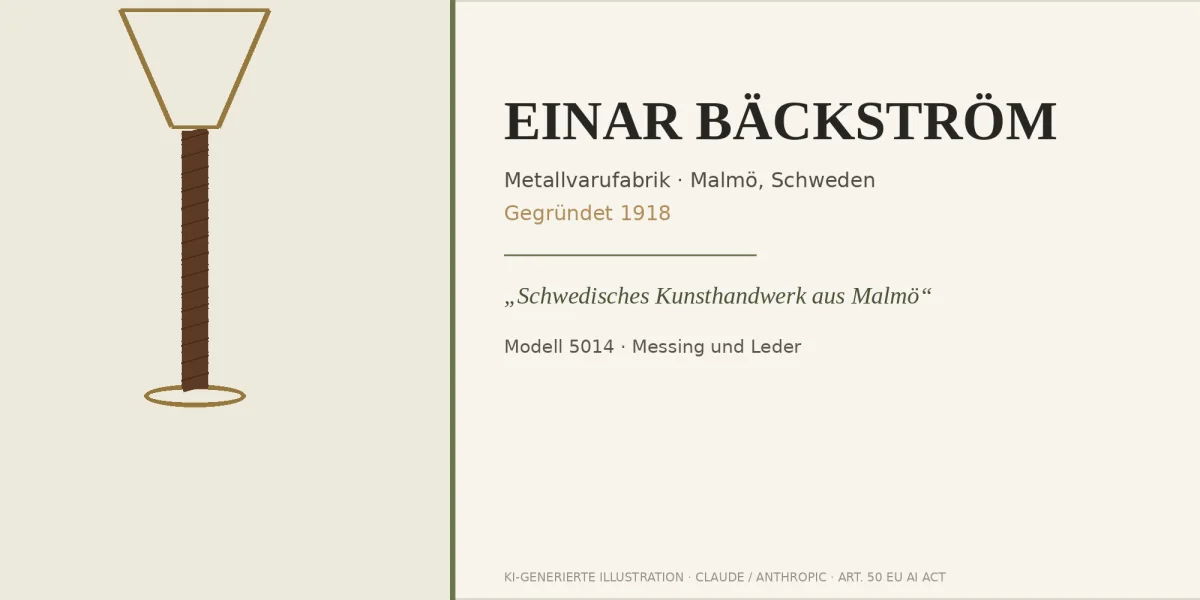
erreicht das Programm mit dem berühmten Modell 5014 seinen internationalen Höhepunkt. Diese Tischleuchte ist bis heute die bekannteste Signature-Serie des Hauses: ein schlanker, matt gebürsteter Messingfuß, dessen Stiel vollständig in dunkelbraunes, gedrehtes Rindsleder gewickelt ist, kombiniert mit einem konischen, außen lackierten und innen weiß beschichteten Messingschirm. Das Modell 5014 misst typischerweise rund 43 cm in der Höhe bei einem Schirmdurchmesser von rund 30 cm und ist auf E27-Fassung ausgelegt. Es gilt als Ikone des schwedischen Mid-Century-Modernismus und ist in nahezu allen internationalen Design-Sammelplattformen (1stDibs, Modernity, Pamono, H. Gallery, Design Addict) dokumentiert.
Die 1950er und 1960er
ahre stehen im Zeichen des internationalen Scandinavian-Modern-Booms. Die Bäckström-Werkstatt liefert nun Pendel-, Decken- und Stehleuchten aus mattem oder lackiertem Messing, häufig mit sternförmig perforierten Konusschirmen aus Aluminium- oder Messingblech, sowie mehrarmige Pendel- und Deckenleuchten mit drei geschwungenen Messingarmen. Diese Modelle stehen typologisch der zeitgleichen italienischen Modernisten-Beleuchtung (Stilnovo, Arteluce) nahe und werden bis heute im schwedischen Vintage-Handel als Klassiker gehandelt.
Prägende Zusammenarbeit: Erik Höglund und Boda Glasbruk
Die designhistorisch wichtigste Kooperation der späten Bäckström-Ära ist die Zusammenarbeit mit dem schwedischen Glaskünstler Erik Höglund (1932 – 1998). Höglund war ab 1953 künstlerischer Leiter bei Boda Glasbruk (Småland) und einer der einflussreichsten schwedischen Glasgestalter der Nachkriegsmoderne. In den 1950er und vor allem 1960er Jahren entstanden gemeinsame Pendel- und Deckenleuchten, in denen Einar Bäckström die Metallgestelle aus Messing und lackiertem Stahl fertigte und Erik Höglund die gegossenen, mundgeblasenen oder handgeformten Glaselemente in Klarglas und Rotglas beisteuerte. Charakteristisch sind Reliefgläser mit stark strukturierter Oberfläche, die dem Licht ein lebendiges, tiefengestaffeltes Spiel verleihen. Diese Leuchten sind heute Sammlerklassiker und in mehreren internationalen Katalogen und bei Pamono, 1stDibs, Selency, Vinterior und Scandinavian Modernists dokumentiert.
Ikonische Modelle und Signature-Serien
Modell 9095 – Tischleuchte, frühe 1930er Jahre: eine der frühen Swedish-Grace-Tischleuchten des Hauses, patinierter Messingsockel mit klassischer Ornamentik.
Modell 1290 – Tischleuchte, 1930er Jahre: strenger, funktionalistischer Messingkorpus, dokumentiert u.a. bei Bukowskis Stockholm.
Modell 5014 – Tischleuchte, 1940er Jahre (Signature-Modell): matt gebürsteter Messingfuß, mit dunklem, gewickeltem Leder ummantelter Stiel, konischer Messingschirm, ca. 43 cm hoch, E27-Fassung. Die international bekannteste Bäckström-Leuchte und Referenzobjekt für das schwedische „Modern"-Idiom der 1940er Jahre.
Pendel- und Deckenleuchten mit Sternperforation – 1950er/1960er Jahre: konische Messing- oder Aluminium-Konusschirme mit sternförmig ausgestanzten Löchern; gefertigt in Ein- und Mehrarmvarianten.
Mehrarmige Messing-Pendelleuchten – 1950er/1960er Jahre: dreiarmige, geschwungene Messingpendelleuchten mit konischen Schirmen, typologisch verwandt mit italienischen Vorbildern.
Pendel- und Deckenleuchten in Kooperation mit Erik Höglund / Boda Glasbruk – 1950er/1960er Jahre: kubistische, farbig gefasste Metallrahmen mit Klar- oder Rotglas-Einsätzen. Sammlerklassiker der Scandinavian-Modern-Ära.
Stehleuchten aus Messing und Leder – 1930er/1940er Jahre: „Scandinavian Floor Lamp"-Typus in Messing und Leder, in mehreren Größen ausgeführt.
Frühe Zinngefäße und Bonbonnièren – 1920er Jahre: kunsthandwerkliche Serien aus der frühen Werkstatt, teils über Nordiska Kompaniet in Stockholm vertrieben, in Sammlerkreisen unter dem Meistermerkmal „E.B." dokumentiert.
Auszeichnungen, museale Präsenz und historische Referenzen
Einar Bäckströms Metallvarufabrik gehört zu jenen Manufakturen, die weniger durch spektakuläre Einzelpreise als vielmehr durch die kontinuierliche museale und sammlerische Anerkennung des Gesamtwerks in Erscheinung getreten sind. Das Malmö Museum verwahrt Firmen- und Musterdokumentation der Manufaktur und dokumentiert insbesondere, dass Einar Bäckström die Muster selbst komponierte. In der 1925 anlässlich der Pariser Weltausstellung erschienenen Publikation Erik Wettergrens „L'art décoratif moderne en Suède" (Malmö Museum) wird das Haus im Kontext der schwedischen dekorativen Kunst der 1920er Jahre besprochen. Die Signature-Serie Modell 5014 sowie die Zusammenarbeit mit Erik Höglund und Boda Glasbruk bilden einen festen Bestandteil des internationalen Sammlerkanons des schwedischen Mid-Century-Modernismus und sind in laufender Auktions-, Museums- und Fachhandels-Rezeption vertreten (Bukowskis Stockholm, Auctionet, Modernity Stockholm, Pamono, 1stDibs).
Kennzeichnung, Marken und Firmierung
Historische Firmierung: „Einar Bäckströms Metallvarufabrik" (schwedisch für „Einar Bäckströms Metallwarenfabrik"). Kurzformen im Sprachgebrauch: „EBM", „Bäckström Malmö", „Einar Bäckström Malmö". Für die Zinnproduktion des Bruders Sune Bäckström existiert die eigene Marke „Bäckström Tenn". Als Zinnstempel ist das Meistermerkmal „E.B." im Verzeichnis der schwedischen Tennstämplar dokumentiert (Kennzeichnung ab der Registrierung 1913 im Sinne des schwedischen Zinnstempelgesetzes). Die Beleuchtungsarmaturen sind – je nach Modell und Fertigungsphase – mit Werksstempel „EINAR BÄCKSTRÖM MALMÖ" bzw. „E.B.M." punziert.
Historische Sitze und Wettbewerbsumfeld
Erster Betriebssitz (Registrierung 1918): Stora Nygatan 57, Malmö. Hauptbetrieb ab den frühen 1920er Jahren: Föreningsgatan 8, Malmö (Verwaltung, Fabrikation, Ausstellungs- und Verkaufsraum). Zusätzlicher Ausstellungs- und Ladenraum: Hamngatan 2, Malmö. Betriebsende: 1975.
Im schwedischen Wettbewerbsumfeld stand Einar Bäckström neben Arvid Böhlmarks Lampfabrik (Stockholm, seit 1872) und Bergboms (Malmö) für die höherwertige, gestalterisch anspruchsvolle Wohnraumbeleuchtung Schwedens. Anders als Böhlmarks, das seine Kollektion in großen Serien durch renommierte Gastdesigner (u.a. Harald Notini, Hans Bergström) entwickeln ließ, konzentrierte Bäckström die Entwurfsarbeit bis in die späten Jahre in erster Linie im eigenen Haus – ein deutliches Alleinstellungsmerkmal in der schwedischen Leuchtenindustrie der Moderne.
Referenzen und Quellen
Wikipedia (sv) – Einar Bäckströms metallvarufabrik: https://sv.wikipedia.org/wiki/Einar_B%C3%A4ckstr%C3%B6ms_metallvarufabrik
Auctionist.co – Einar Bäckström (Herstellerprofil): https://auctionist.co/sv/creators/einar-backstrom
Bukowskis – EINAR BÄCKSTRÖM, bordslampa, Einar Bäckströms Metallvarufabrik, Malmö, 1900-talets mitt: https://www.bukowskis.com/sv/lots/1098476-einar-backstrom-bordslampa-einar-backstroms-metallvarufabrik-malmo-1900-talets-mitt
Bukowskis – Einar Bäckströms Metallvarufabrik, bordslampa, modell „1290", Malmö, 1930-tal: https://www.bukowskis.com/sv/auctions/F622/lots/1621751-einar-backstroms-metallvarufabrik-bordslampa-modell-1290-malmo-1930-tal
Auctionet – Ytterfoder, mässing, Einar Bäckström, Malmö: https://auctionet.com/sv/1927574-ytterfoder-massing-einar-backstrom-malmo
Auctionet – Bonbonjär, Einar Bäckström Metallvarufabrik, Malmö, Svenskt Tenn, omkring 1920/30-tal: https://auctionet.com/sv/4186160-bonbonjar-einar-backstrom-metallvarufabrik-malmo-svenskt-tenn-omkring-1920-30-tal
precisensan.com – Dokumentation Bäckströms i Malmö (Sammler- und Fachforum): https://www.precisensan.com/antikforum/forum/forum-antikt-retro-design/mineraler-metaller-smycken/koppar-m-ssing-j-rn-tenn-legeringar/9503-dokumentation-b-ckstr-ms-i-malm
Auktion.se – Einar Bäckströms metallvarufabrik, annonser i original, foton, kassabok, ritningar: https://auktion.se/objekt/1591641/einar-backstroms-metallvarufabrik-annonser-i-original-foton-kassabok-ritningar
Modernity Stockholm – Table lamp model 5014 by anonymous for Einar Bäckströms Metallvarufabrik: https://www.modernity.se/product/table-lamp-model-5014-by-anonymous-for-einar-backstroms-metallvarufabrik
Modernity Stockholm – Pair of table lamps model 5014 designed by Einar Bäckström: https://www.modernity.se/pair-of-table-lamps-model-5014-designed-by-einar-backstrom/
H. Gallery – Einar Bäckström „Model 5014" Brass and Leather Table Lamp, Sweden 1940s: https://hgallery.com/archive-3/einar-backstrom-model-5014-brass-and-leather-table-lamp-sweden-1940s-20221424
H. Gallery – Swedish Modern „Model 5014" Brass Table Lamp by Einar Bäckström, Sweden 1940s: https://hgallery.com/lighting/swedish-modern-model-5014-brass-table-lamp-by-einar-backstrom-sweden-1940s-20221415
1stDibs – Einar Bäckström Brass and Leather Table Lamp, Sweden, 1930s: https://www.1stdibs.com/furniture/lighting/table-lamps/einar-backstrom-brass-leather-table-lamp-sweden-1930s/id-f_1275264/
1stDibs – Einar Backstrom (Creator page, Lighting): https://www.1stdibs.com/creators/einar-backstrom/furniture/lighting/
1stDibs – Model 5014 brass table lamp by Einar Backstrom (Search results): https://www.1stdibs.com/buy/model-5014-brass-table-lamp-by-einar-backstrom
1stDibs – Swedish Mid-Century Floor Lamp Einar Backstrom Malmö Metallvarufabrik: https://www.1stdibs.com/furniture/lighting/floor-lamps/swedish-mid-century-floor-lamp-einar-backstrom-malmo-metallvarufabrik/id-f_29174152
Incollect – Einar Backstrom (Artist page, Lighting Lamps & Mirrors): https://www.incollect.com/artists/einar-backstrom
Incollect – Einar Bäckström brass and leather floor lamp, Sweden: https://www.incollect.com/listings/furniture/lighting/einar-backstrom-einar-b-ckstr-m-brass-and-leather-floor-lamp-sweden-269858
Design Addict – Table lamp, Einar Bäckström, Sweden, 40ies, brass, leather: https://designaddict.com/produit/table-lamp-einar-backstrom-sweden-40ies-brass-leather/
Pamono – Mid-Century Modern Pendant Lamp by Einar Bäckström, 1950s: https://www.pamono.com/mid-century-modern-pendant-lamp-by-einar-baeckstroem-1950s
Pamono – Swedish Ceiling Light by Einar Bäckström and Erik Höglund, 1960s: https://www.pamono.com/swedish-ceiling-light-by-einar-baeckstroem-and-erik-hoeglund-1960s
Pamono – Swedish Ceiling Light by Einar Bäckström and Erik Höglund: https://www.pamono.com/swedish-ceiling-light-by-einar-baeckstroem-and-erik-hoeglund-1
Scandinavian Modernists – Large Einar Bäckström & Erik Höglund Pendant Lamp, 1950s: https://scandinavianmodernists.com/products/large-einar-backstrom-erik-hoglund-pendant-lamp-1950s
Vinterior – Swedish Pendants by Einar Bäckström & Erik Höglund, Set of 2: https://www.vinterior.co/lighting/ceiling-lights/pendants/swedish-pendants-by-einar-backstrom-erik-hoglund-set-of-2
Selency – Swedish chandelier by Einar Bäckström and Erik Höglund: https://www.selency.co.uk/p/TDC6PSDP/swedish-chandelier-by-einar-backstrom-and-erik-hoglund
Antikform – Sune Bäckström, Einar Bäckström Metallvarufabrik: https://antikform.se/produkt/sune-backstrom-einar-backstrom-metallvarufabrik/
Antikform – Sune och Einar Bäckström (Golvlampor): https://antikform.se/produkt/golvlampor-einar-backstrom/
RetroCrafts – Taklampa Einar Bäckström, glas och plåt: https://retrocrafts.se/produkt/taklampa-einar-backstrom-glas-plat/
Bloomberry – Einar Backstrom table lamp, Sweden: https://bloomberry.eu/furniture/lighting/einar-backstrom-table-lamp-sweden
vntg.com – Einar Bäckström (Designer-Übersicht): https://www.vntg.com/designer/einar-b%C3%A4ckstr%C3%B6m/
Remodern Vintage – Einar Bäckströms Metallvarufabrik table lamp 1940s: https://remodernvintage.com/en/products/einar-backstroms-metallvarufabrik-poytavalaisin-1940-luku
macacke.com – Svenska Tennstämplar B (Verzeichnis schwedischer Zinnstempel, u.a. „E.B."): https://macacke.com/svenskttenn/marks/svenska_tennstamplar/tennstamplar_b.html
artOrigo – Einar Bäckström brass and leather floor lamp, Sweden: https://artorigo.com/lighting/einar-backstrom-brass-and-leather-floor-lamp-sweden/id-5965